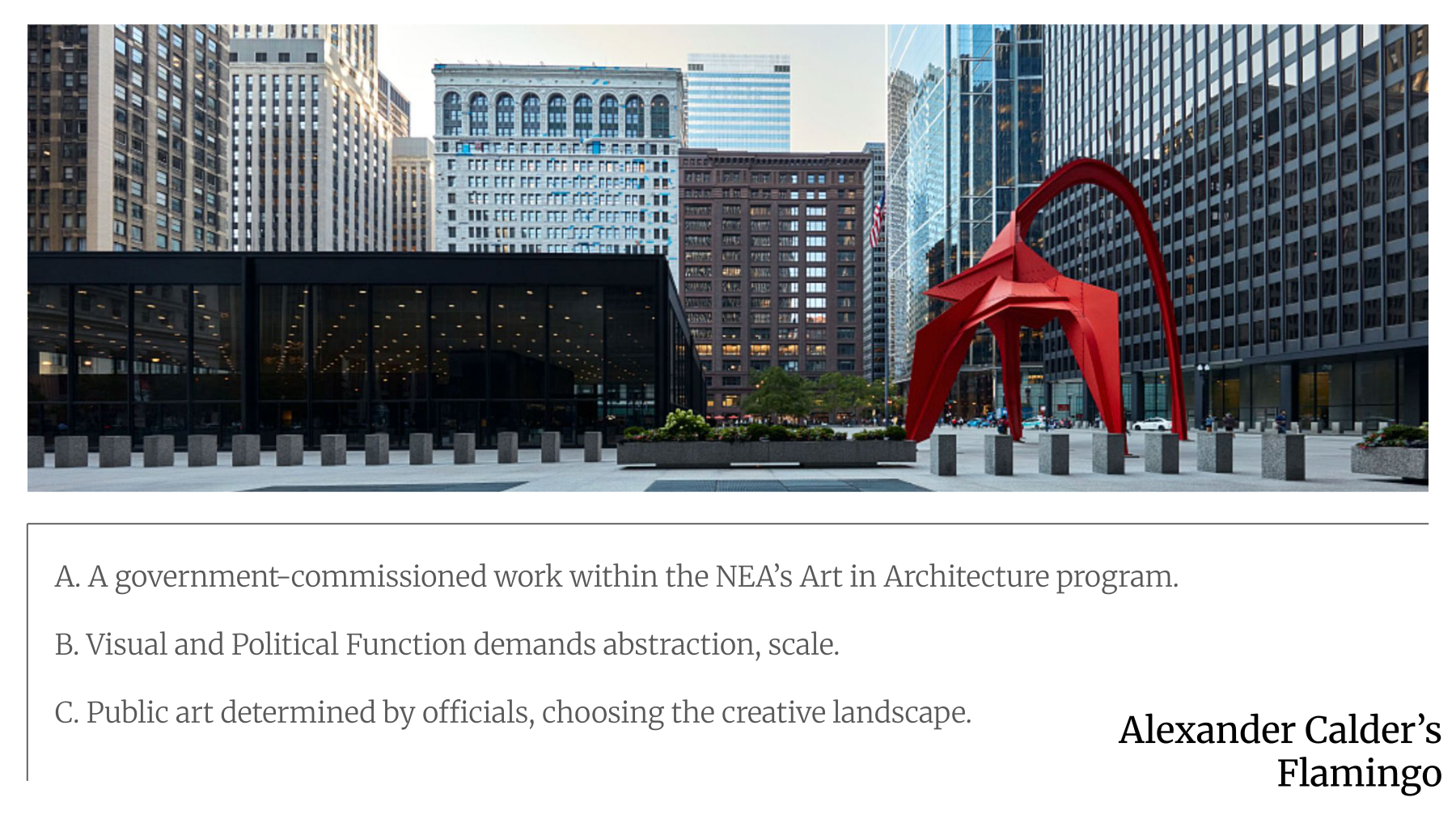
The entanglement of aesthetics and power also appears in the federal government’s commissioning of public art. Alexander Calder’s Flamingo, installed in Chicago’s Federal Plaza in 1974, was the first major project funded through the General Services Administration’s Art in Architecture program. The bright red steel sculpture, abstract and monumental, was intended to soften the rigid geometry of the surrounding government buildings.
As Amy Sabrin argues, government arts funding always raises questions about the relationship between patronage and autonomy. Calder’s Flamingo appears apolitical, yet its very neutrality serves a political purpose. It presents an image of democratic pluralism and cultural vitality within a federal landscape that might otherwise seem impersonal or oppressive.
Francis Hodsoll’s reflections on the NEA during the 1980s underscore the tensions inherent in government involvement in the arts. Flamingo, with its abstract form and cheerful color, aligns with a particular vision of culture that avoids controversy and affirms national unity. In this sense, abstraction becomes a political tool. It allows the government to sponsor art that appears universal while subtly reinforcing the values of order, stability, and civic harmony.